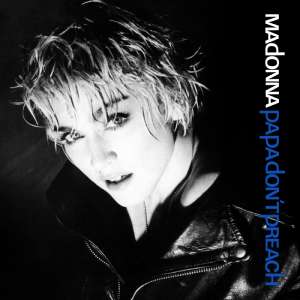
When “Papa Don’t Preach” was released in June 1986 as the lead single from Madonna’s third studio album True Blue, it immediately ignited controversy and acclaim. The song tells the story of a young woman who informs her father that she’s pregnant and intends to keep the baby, despite knowing it may disappoint him. Co-written by Brian Elliot and Madonna, the lyrics tackle themes of female agency, familial conflict, and teenage pregnancy—territory rarely explored so directly in mainstream pop music at the time. Musically, the track marked a stylistic shift from Madonna’s earlier dance-pop hits, incorporating a lush orchestral arrangement and a more mature vocal delivery that signaled her evolution as an artist. Produced by Stephen Bray and Madonna, the song opens with dramatic strings before launching into a driving pop-rock rhythm, reflecting the seriousness of the subject matter without losing its radio-friendly appeal.
The video, directed by James Foley, deepened the song’s narrative with visuals of Madonna playing a working-class young woman struggling with a life-changing decision. Her cropped, platinum-blonde hairstyle and tough-yet-vulnerable persona further reinforced her transformation from bubblegum star to confident storyteller. The video’s mix of domestic imagery and urban grit, along with Madonna’s emotional performance, helped humanize the storyline and added resonance to the song’s already provocative lyrics. “Papa Don’t Preach” quickly climbed the charts, becoming Madonna’s fourth No. 1 on the Billboard Hot 100 and earning her both praise and backlash. Conservative groups criticized her for allegedly glamorizing teen pregnancy, while feminist organizations were divided over whether the song promoted female empowerment or reinforced patriarchal values. Madonna, never one to shy away from controversy, leaned into the public debate, using it to highlight double standards about morality and reproductive choices.
Over time, “Papa Don’t Preach” has come to be seen as one of Madonna’s most impactful and socially resonant tracks. It showcased her willingness to address complex issues through the lens of pop music and helped cement her reputation as a boundary-pushing artist unafraid of public scrutiny. The song remains a staple in her catalog and a powerful example of how pop can be used to challenge cultural norms. More than just a hit single, “Papa Don’t Preach” was a bold cultural statement—one that sparked conversation, expanded Madonna’s artistic identity, and proved that pop music could be both commercially successful and deeply thought-provoking.
|
|
SINGLES
Live to Tell
Papa Don't Preach
True Blue
Open Your Heart
La Isla Bonita
|