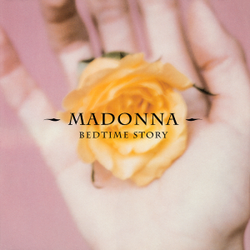
Released in February 1995 as the third single from Bedtime Stories, Madonna’s Bedtime Story marked one of the most daring and experimental moments of her 1990s output. Co-written by Björk, Nellee Hooper, and Marius De Vries, the track abandoned the album’s smoother R&B textures in favor of hypnotic, electronic, and trip hop-inspired soundscapes. Its driving beat, icy synth layers, and trance-like repetition set it apart from Madonna’s usual pop structures, emphasizing mood over melody. Lyrically, the song rejects rationality and language in favor of dreams and subconscious experience: “Words are useless, especially sentences.” This abstract focus resonated with Madonna’s ongoing interest in pushing the boundaries of pop, suggesting a desire to move away from literal storytelling into a space of sound, sensation, and surrealism.
The song’s most iconic element, however, is its groundbreaking music video, directed by Mark Romanek. Widely considered one of Madonna’s most visually ambitious works, the video was a surreal, dreamlike spectacle filled with striking imagery drawn from art, mythology, and science. Madonna appears in a series of hallucinatory sequences: floating in a womb-like space, giving birth to doves, and morphing into abstract forms. Its dense symbolism evokes themes of spirituality, technology, and rebirth, positioning Madonna less as a pop star and more as an avant-garde visual artist. The video, with its heavy use of computer-generated effects, was one of the most expensive of its time and is still regarded as a milestone in music video history for its daring aesthetic and conceptual ambition.
Though not a major commercial hit compared to her earlier singles, Bedtime Story reached the top ten in the UK and found success on the U.S. dance charts, where its hypnotic sound resonated in club culture. More importantly, it reinforced Madonna’s reputation as a fearless experimenter willing to step outside mainstream expectations. Critics admired her bold collaboration with Björk and recognized the single as a precursor to her later full embrace of electronic music on Ray of Light (1998). Over time, Bedtime Story has been reappraised as a crucial transitional work—an artistic statement that bridged her mid-1990s R&B period with the futuristic, spiritual explorations that would define her next reinvention. Today, it stands as one of her most daring and innovative singles, proof of her ability to transform pop into something visionary, experimental, and enduringly ahead of its time.
|
|
SINGLES
Secret
Take a Bow
Bedtime Story
Human Nature
|