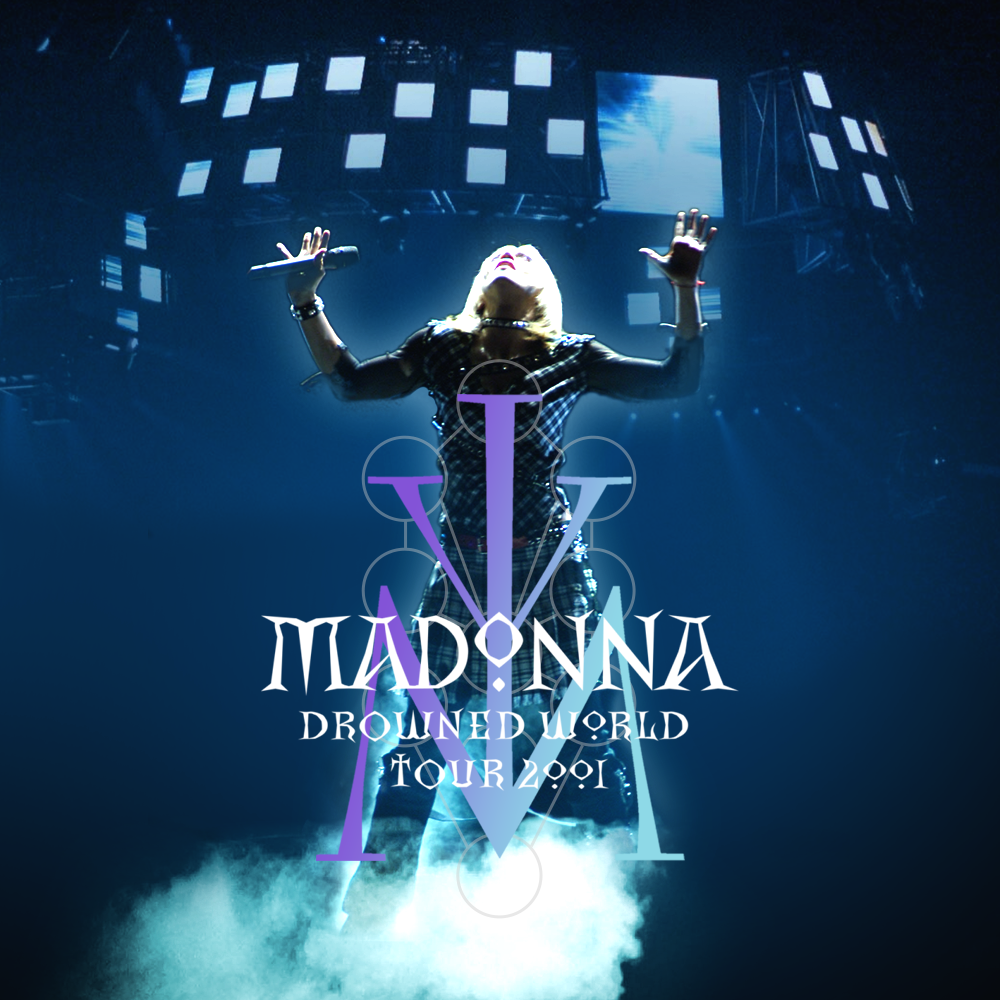
Madonna’s Drowned World Tour, launched in June 2001, marked her long-awaited return to the stage after an eight-year break from touring. Following the Girlie Show Tour of 1993, she had focused on film projects, motherhood, and a musical reinvention, but with the success of Ray of Light (1998) and Music (2000), she was ready to perform live again. The title drew inspiration from J.G. Ballard’s novel The Drowned World and echoed the futuristic, introspective tone of her recent work. The tour visited Europe, the United States, and Canada, selling out arenas and becoming one of the most talked-about concert events of the early 2000s. It was also her first major tour to heavily incorporate new technology, video backdrops, and a darker theatricality that emphasized artistry as much as spectacle.
The show was divided into thematic segments, each with its own story and visual aesthetic. The opening act, “Rock ’n’ Samurai,” combined cyberpunk imagery with Japanese martial arts, as Madonna appeared in black leather, guitar in hand, performing “Drowned World/Substitute for Love.” Later segments included “Geisha Anime,” which blended eastern iconography with surreal pop visuals, and “Country/Western,” a nod to the cowboy style of her Music era, complete with acoustic numbers like “I Deserve It.” The “Latino/Gypsy” finale celebrated dance, rhythm, and vibrancy, bringing the concert to a euphoric close. Each section showcased Madonna’s ability to transform both musically and visually, weaving together past hits and newer material in a way that felt cohesive and theatrical rather than nostalgic.
Critics praised the tour for its ambition and innovative design, though some noted the setlist leaned heavily on recent albums rather than classic hits. Still, tracks like “La Isla Bonita,” “Holiday,” and “Like a Virgin” were reimagined to fit the show’s darker, more experimental atmosphere. The choreography, elaborate costumes by designers such as Jean-Paul Gaultier, and cutting-edge visuals established the production as a new standard for pop concerts. Fans were especially struck by Madonna’s renewed confidence on stage, blending her established star power with the artistic maturity she had developed in the late 1990s.
Commercially, the Drowned World Tour was a major success, grossing around $75 million from just 47 shows, cementing Madonna’s status as the highest-grossing female touring artist at the time. It demonstrated her ability not only to evolve musically but also to reinvent the very idea of what a pop concert could be—intimate, theatrical, and global in scope. The tour was later released as an HBO special and DVD, extending its legacy and influence. More than just a comeback, it was a reassertion of Madonna as a fearless performer who could command both cultural relevance and box office dominance two decades into her career.
|