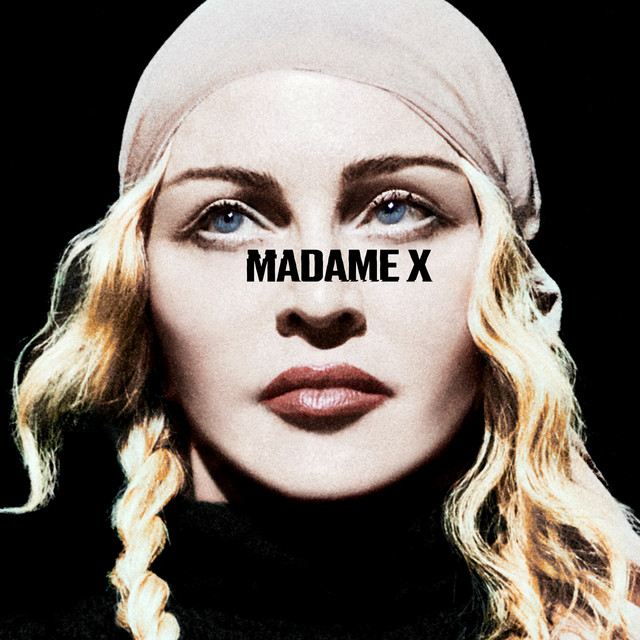
Madonna’s Madame X, released in 2019, is one of the most adventurous and globally inspired projects of her career. Rather than following mainstream pop formulas, the album embraces a collage of sounds shaped by her years living in Lisbon, Portugal. Fado, morna, reggaeton, Latin trap, and Afrobeat all find a place alongside her usual pop sensibility. The concept of “Madame X” itself—an alter ego who is a secret agent, traveler, and shapeshifter—serves as a guiding persona, allowing Madonna to experiment freely with style and narrative. The result is an album that defies categorization, pulling listeners into a world that is both deeply personal and politically charged.
Lyrically, Madame X reflects Madonna’s concerns with freedom, resistance, and social justice. Tracks like “God Control” tackle the urgency of gun control in America, fusing disco-inspired production with darkly satirical lyrics. “Killers Who Are Partying” presents a raw reflection on privilege and solidarity, where Madonna adopts the voices of marginalized groups to declare unity with their struggles. At the same time, she indulges in playful escapism with “Faz Gostoso,” a collaboration with Brazilian singer Anitta, which brings high-energy baile funk rhythms into the mix. This combination of protest music and dance-floor anthems highlights the duality of Madame X—a record that is equal parts confrontation and celebration.
The album is also notable for its collaborative spirit. Madonna works with artists like Maluma on “Medellín,” blending Latin pop and reggaeton, while Swae Lee joins her on the melancholic “Crave.” The presence of Portuguese musicians, including the Cape Verdean collective Orquestra Batukadeiras, lends authenticity to songs such as “Batuka,” which celebrates resilience through communal drumming and chants. This international roster underscores Madonna’s belief in music as a borderless language, capable of uniting cultures and carrying urgent messages across divides. Even her ballads, like “Extreme Occident” and “Looking for Mercy,” feel expansive, pulling in emotional textures that balance the album’s more radical sonic experiments.
Ultimately, Madame X stands as one of Madonna’s boldest reinventions. It is less concerned with chasing chart success than with artistic expression and cultural dialogue. While some listeners found it challenging or disjointed, others praised it as proof that Madonna, four decades into her career, still refuses to be predictable. Through its daring mix of genres and strong political voice, Madame X positions Madonna not just as a pop icon but as a restless artist, willing to risk alienation in pursuit of reinvention. The album challenges its audience to listen deeply, to dance, and to reflect—an invitation that is both provocative and enduring.
|